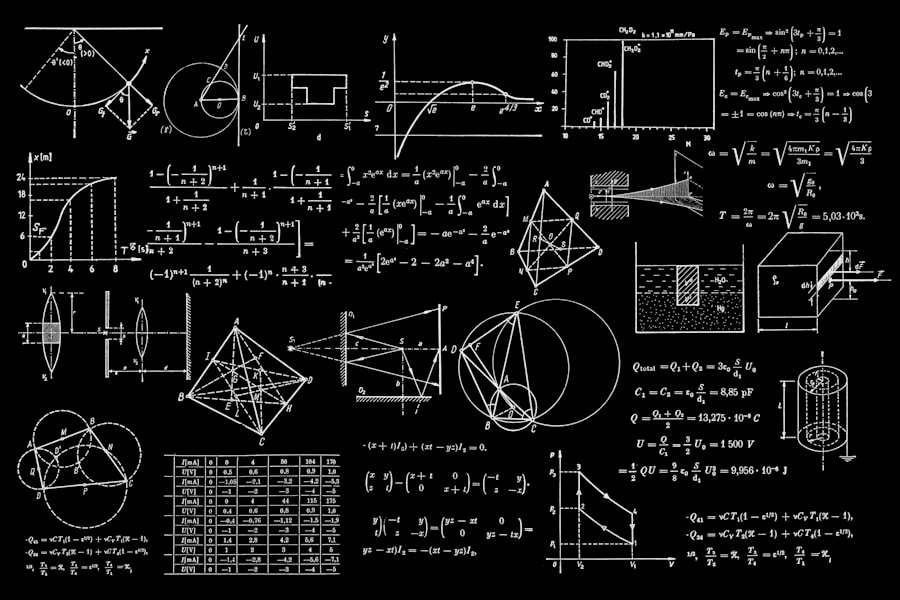
What is Quantum Mechanics?
Quantum mechanics is the branch of physics describing nature at atomic and subatomic scales. At this scale, particles behave in ways that defy classical intuition — they exist as probability waves until observed, can be "entangled" across any distance, and tunnel through barriers they classically shouldn't be able to cross.
Schrödinger's wave function · Heisenberg's Uncertainty Principle
Core Concepts
Wave-Particle Duality
Light and matter exhibit both wave-like and particle-like properties depending on how they are measured.
Superposition
A quantum system exists in all possible states simultaneously until a measurement collapses it to one state.
Entanglement
Two particles become correlated such that measuring one instantly affects the other, regardless of distance.
Quantum Tunnelling
Particles can pass through energy barriers — the principle behind transistors and nuclear fusion in the Sun.
Observer Effect
The act of measuring a quantum system fundamentally changes its state — the universe "watches" itself into being.
Many-Worlds
Every quantum event spawns branching universes — one for each possible outcome. You exist in all of them.
Quantum Computing Connection
As a Computer Science student, quantum mechanics directly applies to my field. Quantum computers use qubits — which can be 0, 1, or both simultaneously — to solve certain problems exponentially faster than classical computers. Shor's algorithm could break RSA encryption. Grover's algorithm offers quadratic speedup for database search. The quantum revolution is coming to software engineering.
"If you are not completely confused by quantum mechanics, you do not understand it."
— John Wheeler, Physicist"Anyone who is not shocked by quantum theory has not understood it."
— Niels Bohr